In the high-density districts of Dubai and Abu Dhabi, a single structural miscalculation during a teardown doesn’t just halt a project; it can compromise the integrity of an entire city block. Maintaining rigorous urban demolition safety standards isn’t merely a matter of compliance. It’s a fundamental engineering discipline required to protect the public and preserve neighboring assets. You likely recognize the immense pressure of navigating shifting municipal circulars while managing the physical risks and legal liabilities of a multi-story dismantling.
This 2026 engineering reference guide provides the technical clarity you need to master these complex regulatory requirements and execute high-stakes projects with absolute precision. We’ve developed a framework that moves beyond basic site safety to address the core challenges of structural stability and risk mitigation. You’ll gain a comprehensive understanding of the latest UAE safety codes, specialized shoring protocols, and the systematic risk assessments necessary to ensure every phase of your project remains stable and secure.
Key Takeaways
- Navigate the 2026 Dubai Municipality and Abu Dhabi DMT regulatory frameworks to ensure full compliance for high-density demolition projects.
- Implement rigorous urban demolition safety standards by utilizing specialized shoring and piling to protect the structural integrity of neighboring buildings.
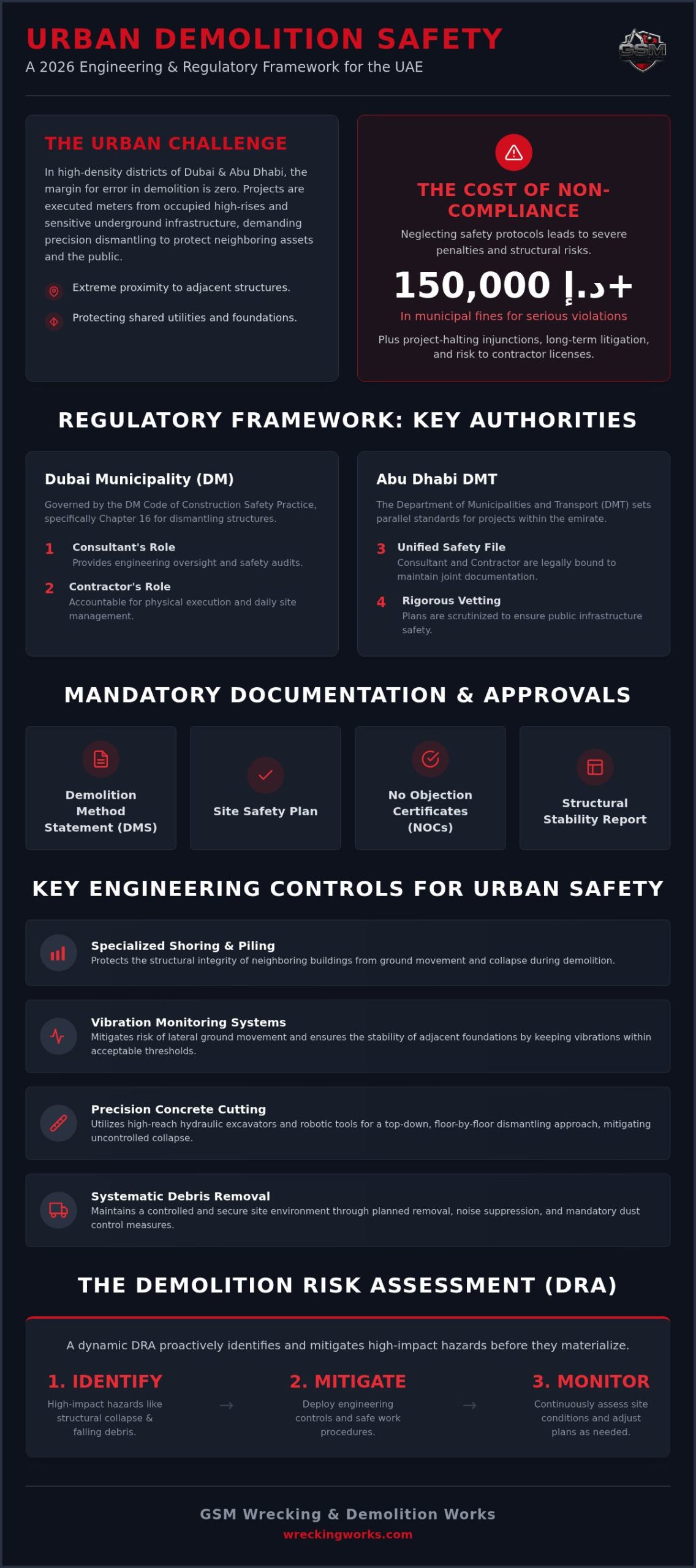
- Develop a dynamic Demolition Risk Assessment (DRA) that proactively identifies high-impact hazards such as structural collapse and falling debris.
- Deploy vibration monitoring systems to mitigate the risk of lateral ground movement and ensure the stability of adjacent foundations during dismantling.
- Master the integration of precision concrete cutting and systematic debris removal to maintain a controlled and secure site environment throughout the project lifecycle.
The Landscape of Urban Demolition Safety in the UAE
The UAE’s skyline is a testament to rapid engineering evolution, but the 2026 infrastructure pipeline brings a new level of complexity to site preparation. In densely populated districts like Downtown Dubai or the Al Reem Island corridor, the margin for error is zero. High-stakes building demolition requires a transition from brute force to technical dismantling. Adhering to modern urban demolition safety standards isn’t just about ticking boxes; it’s the only way to ensure structural integrity in a landscape where every building is tethered to a shared network of utilities and foundations.
The industry has moved away from traditional wrecking ball methods. We now rely on high-reach hydraulic excavators and robotic precision tools. This shift allows for a top-down, floor-by-floor approach that mitigates the risk of uncontrolled collapse. With the projected growth of urban renewal projects through 2026, these standards have become more rigorous to accommodate the extreme proximity of adjacent structures.
Understanding the Urban Constraint
Urban sites in the UAE are rarely isolated. Most projects occur within meters of occupied high-rises or sensitive underground infrastructure, such as DEWA or ADDC utility tunnels. Managing these constraints requires a systematic approach to public safety. Pedestrian protection isn’t just a fence; it’s a structural barrier designed to contain debris and dampen the acoustic impact of heavy machinery. Implementing these urban demolition safety standards ensures that vibration limits remain within acceptable thresholds, preventing cosmetic or structural damage to neighboring towers. Effective noise and dust suppression are mandatory to maintain municipal compliance and avoid community disruption.
The Cost of Non-Compliance
Neglecting safety protocols leads to more than just project delays. It invites significant legal liabilities and municipal fines that can exceed د.إ 150,000 for serious violations. Beyond financial penalties, the structural risks to neighboring properties are immense. A failure to conduct a thorough pre-demolition survey can result in foundation settlement or lateral ground movement in adjacent plots. This often leads to project-halting injunctions and long-term litigation.
Insurance providers for high-risk works now demand proof of engineering-led risk mitigation before coverage is even considered. Without a documented safety framework, a contractor isn’t just risking a fine; they’re risking their license and the stability of the surrounding urban fabric. Ensuring peace of mind for stakeholders requires a “safe pair of hands” that prioritizes methodical execution over speed.
Regulatory Framework: Dubai Municipality and Abu Dhabi DMT Standards
Compliance with urban demolition safety standards in the UAE is governed by two primary bodies: the Dubai Municipality (DM) and the Abu Dhabi Department of Municipalities and Transport (DMT). The DM Code of Construction Safety Practice serves as the technical benchmark for all works in Dubai, specifically Chapter 16, which outlines the rigorous controls required for dismantling structures. This framework mandates a clear division of responsibility. The appointed Consultant provides engineering oversight and safety audits, while the Contractor is held accountable for the physical execution and daily site management. Neither party can operate in isolation; they’re legally bound to maintain a unified safety file.
Every project requires a comprehensive Demolition Method Statement (DMS) and a Site Safety Plan before a single hammer is swung. These aren’t just administrative requirements; they’re operational blueprints. They must detail the exact sequence of dismantling, the machinery used, and the specific engineering controls deployed to prevent an unplanned structural failure. In high-density areas, these documents are reviewed with extreme scrutiny to ensure the safety of the surrounding public infrastructure.
Key Local Permit Requirements
Securing No Objection Certificates (NOCs) is the first critical phase of any project. You’ll need clearances from DEWA for utility disconnections, Etisalat or Du for telecommunications protection, and the RTA for traffic management if the site borders a public road. A Structural Stability Report is also mandatory. This engineering assessment proves that the building can withstand the demolition sequence without collapsing onto adjacent plots. For residential projects, following specific protocols for villa demolition services in Dubai ensures that work in quiet neighborhoods meets municipal noise, vibration, and dust limits. This methodical approach prevents the legal liabilities that arise from damaging shared boundary walls or underground services.
International Standards Integration
While local codes are the primary authority, integrating ISO 45001 ensures a globally recognized health and safety management system is in place. Many UAE contractors adapt UK HSE principles, particularly regarding “Work at Height” and “Exclusion Zones.” However, these must be modified for the UAE’s unique environmental factors. High ambient temperatures and humidity during the summer months affect both worker fatigue levels and machinery hydraulic performance. A certified safety officer must remain on-site throughout the duration of the works to monitor real-time hazards and ensure all personnel adhere to the approved DMS. If you’re managing a complex site, partnering with a team that understands these urban demolition safety standards provides the stability your project needs to proceed without incident.
Engineering Controls for Structural Stability and Neighboring Protection
Translating regulatory theory into site-level execution requires a rigorous application of engineering controls. In the context of the UAE’s vertical cities, urban demolition safety standards dictate that structural stability must be maintained not just for the target building, but for the entire surrounding ecosystem. We utilize a combination of controlled dismantling and active structural reinforcement to mitigate the risks associated with load redistribution. Precision concrete cutting and core drilling often serve as the first line of defense, allowing us to isolate structural elements and disconnect shared slabs without transmitting destructive vibrations to adjacent foundations.
The choice between top-down dismantling and high-reach mechanical demolition is driven by site geometry and structural health. For ultra-high-density plots, a top-down approach is frequently the safest methodology. By removing weight floor-by-floor using small-scale robotic equipment, we maintain the building’s center of gravity and prevent the lateral surges that can occur during large-scale collapses. High-reach excavators, while efficient, require expansive exclusion zones and precise wind-speed monitoring to ensure debris remains contained within the site boundaries.
Advanced Shoring and Piling for Site Safety
When a demolition project involves deep basements or is situated adjacent to older structures with shallow foundations, shoring works become a mandatory safety standard. We implement several specialized techniques to prevent soil subsidence and lateral ground movement:
- Secant Piling: Creates a continuous interlocking wall that provides both structural support and a water-tight seal, essential for protecting neighbors during sub-structure removal.
- Sheet Piling: Utilized for temporary earth retention, ensuring that the removal of a building doesn’t compromise the integrity of public roads or utility corridors.
- Whaler Beams and Struts: These horizontal reinforcements distribute lateral pressure across the shoring system, providing an extra layer of assurance for adjacent high-rises.
Continuous monitoring of structural tilt and settlement is conducted throughout the project lifecycle. Using digital inclinometers and total station surveys, we can detect movements as small as 1mm, allowing for immediate intervention before a hazard develops.
Vibration and Noise Mitigation
Protecting the urban environment means managing the invisible forces of demolition. Before heavy machinery arrives, we establish baseline vibration levels to distinguish project-related activity from ambient city movement. To stay within DMT and Dubai Municipality limits, we prioritize hydraulic concrete crushers over traditional pneumatic breakers. Crushers “chew” through reinforced concrete with minimal noise and virtually no percussive vibration, making them the preferred choice for work near sensitive foundations. Acoustic shielding and strict adherence to municipal work windows further ensure that our operations remain compliant and non-disruptive to the local community.
Developing a Comprehensive Demolition Risk Assessment (DRA)
A Demolition Risk Assessment (DRA) is the mandatory blueprint for all urban site works. Unlike a static checklist, a DRA functions as a dynamic engineering document that evolves alongside the physical state of the structure. Maintaining rigorous urban demolition safety standards requires a proactive identification of “High-Impact” hazards before the first machine is mobilized. We focus on three critical failure points: unplanned structural collapse, the trajectory of falling objects in dense corridors, and the presence of hazardous materials within the building fabric. While we don’t perform abatement, identifying these materials is essential for the safety of our dismantling teams and the surrounding public.
The management of these risks follows a strict hierarchy of controls. We prioritize elimination and engineering solutions over administrative checks or personal protective equipment (PPE). For instance, using a high-reach excavator to dismantle a facade eliminates the need for personnel to work at height, effectively removing a primary fall hazard. By applying this systematic logic, we ensure that every potential incident is mitigated through methodical planning rather than relying on reactive site-level decisions.
Step-by-Step Risk Identification
The assessment begins with a thorough structural survey to uncover hidden weaknesses, such as post-tensioned cables or corroded reinforcement, which could lead to a sudden loss of integrity. In the UAE, wind loads represent a significant variable; a partially demolished structure presents a different aerodynamic profile than a finished building. We calculate the impact of seasonal winds on exposed slabs to ensure lateral stability isn’t compromised during the dismantling sequence. Additionally, mapping underground utilities is vital. We work closely with municipal authorities to ensure total isolation of DEWA and ADDC services, preventing accidental strikes that could cause district-wide outages or site fires.
Mitigation and Emergency Protocols
Once risks are identified, we establish physical mitigation measures. Primary among these is the creation of exclusion zones and designated debris drop areas, which are strictly enforced to prevent unauthorized access. Emergency response planning is equally critical; we maintain clear protocols for structural instability or fire, ensuring every worker knows the evacuation route and assembly point. These risks are not static, so we conduct daily safety briefings, or “Toolbox Talks,” to communicate shifting site conditions to the entire team. This ensures that every operative understands the current state of the building and the specific controls in place for that day’s tasks. If you require a partner who prioritizes this level of engineering discipline, contact our team for a professional site assessment.
Implementing High-Standard Safety with GSM Wrecking & Demolition
GSM Wrecking & Demolition Works operates on the principle that urban demolition safety standards are non-negotiable engineering requirements. We don’t view dismantling as a standalone task; we treat it as a technical challenge that demands an integrated workflow. By combining building demolition with specialized shoring and piling works, we maintain total control over the site’s structural stability from the roof to the foundation. This unified approach eliminates the communication gaps that often occur when multiple contractors handle different phases of site preparation, ensuring a “safe pair of hands” manages your project from start to finish.
Our methodology relies on surgical dismantling through advanced concrete cutting and core drilling. This is particularly critical in multi-story building demolition where we must isolate structural elements without transmitting percussive vibrations to neighboring towers. Once the structural dismantling is complete, our team manages the systematic debris removal and site clearance. We adhere to the highest environmental standards, ensuring that all materials are processed according to municipal regulations in Dubai, Sharjah, and Abu Dhabi. This commitment to site readiness means your plot is handed over clean, stable, and ready for the next phase of development.
Why Engineering Precision Matters
Managing a complex urban site requires more than just heavy machinery; it requires a disciplined approach to risk management. When GSM Wrecking & Demolition Works manages the piling and shoring works alongside the demolition, it safeguards your project’s timeline by preventing soil subsidence and lateral ground movement. We don’t have to wait for third-party engineering approvals between phases; our integrated workflow ensures that the transition from dismantling to excavation works is seamless. This level of coordination provides project stakeholders with full transparency, backed by comprehensive safety reporting and rigorous municipal compliance documentation.
Next Steps for Your Urban Project
Every successful project begins with a methodical site evaluation. Whether you’re managing a residential villa demolition or a complex multi-story commercial project, we customize our safety protocols to meet the specific demands of the location. Our team provides expert consultation on pre-demolition risk assessments and the acquisition of mandatory municipal permits from Dubai Municipality and the DMT. We focus on providing peace of mind through technical mastery and disciplined execution. If you’re planning a high-density project in the UAE, contact GSM Wrecking & Demolition Works to schedule a professional site assessment and ensure your project meets the highest standards of engineering safety.
Securing the Future of UAE Urban Development
The evolution of the UAE’s urban landscape requires a shift from simple dismantling to a rigorous engineering discipline. Mastering urban demolition safety standards ensures that complex projects in high-density districts proceed without compromising public safety or structural integrity. By integrating advanced shoring and piling with surgical concrete cutting, you mitigate the risks of lateral ground movement and foundation settlement. This methodical approach transforms a potentially hazardous task into a controlled, predictable workflow that satisfies both municipal auditors and project stakeholders.
GSM Wrecking & Demolition Works stands as a dependable partner for developers across Dubai, Abu Dhabi, and Sharjah. Our engineering-led approach to site preparation, combined with our specialization in deep excavation and structural shoring, provides the stability required for high-stakes urban renewal. We focus on delivering site readiness through disciplined execution and transparent reporting. It’s about providing the peace of mind that comes from technical mastery and a proven track record in the local market.
Ensure your next project meets the highest safety standards-contact GSM Wrecking today. We look forward to helping you navigate the complexities of 2026 municipal requirements with precision and confidence.
Frequently Asked Questions
What are the mandatory safety permits for demolition in Dubai?
In Dubai, you must obtain a Demolition Permit from Dubai Municipality after securing No Objection Certificates (NOCs) from key utility providers. These include DEWA for power and water disconnections, Etisalat or Du for telecommunications protection, and the RTA for traffic management if your site borders public roads. You’ll also need a Structural Stability Report and a detailed Demolition Method Statement. These documents ensure your project aligns with current urban demolition safety standards and protects public infrastructure.
How do you protect neighboring buildings during a high-rise demolition?
Protecting adjacent structures requires a combination of engineering controls and active monitoring. We utilize specialized shoring and piling works to reinforce shared boundary walls and prevent soil subsidence. During high-rise projects, top-down dismantling with robotic equipment reduces the risk of lateral surges. Real-time vibration monitoring systems are installed on neighboring foundations to ensure that percussive forces remain within safe thresholds, preventing cosmetic or structural damage to nearby towers.
What is a Demolition Method Statement and why is it required?
A Demolition Method Statement is a comprehensive operational blueprint that details the exact sequence and methodology of dismantling. It’s required by UAE municipal authorities to prove that the contractor has identified all structural risks and implemented specific mitigation strategies. The statement covers machinery selection, exclusion zones, and emergency protocols. It serves as a legally binding document that ensures every site operative follows the approved safety sequence to prevent unplanned collapses or accidents.
Are there specific noise and vibration limits for urban demolition in the UAE?
Both Dubai Municipality and the Abu Dhabi DMT enforce strict limits on noise and vibration levels to protect the public. In residential zones, noise must stay below specific decibel thresholds during the day, with heavy work often prohibited at night. Vibration limits are set to prevent structural fatigue in neighboring buildings. We stay compliant by using hydraulic concrete crushers instead of percussive breakers, which significantly reduces the acoustic and seismic impact of our operations.
What role does shoring play in demolition safety?
Shoring provides critical lateral support to prevent ground movement when a building’s foundation is removed or modified. In dense urban environments, it acts as a structural barrier that protects neighboring assets and underground utility networks. By implementing secant or sheet piling, we ensure that the surrounding soil remains stable. This is a fundamental component of urban demolition safety standards, particularly when projects involve deep basements or extreme proximity to high-rise foundations.
How is hazardous material like asbestos managed under UAE safety standards?
Under UAE safety standards, a pre-demolition survey must identify hazardous materials like asbestos or lead-based paints before work begins. While GSM Wrecking specializes in structural dismantling and site preparation, we don’t provide abatement services. Identifying these substances is mandatory to ensure they’re removed by certified specialists before dismantling starts. This prevents the accidental release of toxic fibers into the urban environment, protecting both the workforce and the local community from health risks.
Why is a pre-demolition structural survey necessary?
A pre-demolition structural survey is necessary to identify hidden defects, post-tensioned cables, or corroded reinforcement that could cause an uncontrolled failure. This survey establishes the building’s current load-bearing capacity and guides the dismantling sequence. By understanding how the structure distributes its weight, engineers can plan a safe top-down removal. This process identifies potential high-impact hazards, ensuring that the demolition process doesn’t trigger a sudden structural collapse or impact neighboring plots.
What qualifications should a safety officer have on a UAE demolition site?
A safety officer on a UAE site should hold recognized international certifications such as NEBOSH IGC or IOSH Managing Safely. Additionally, they must be registered and approved by the local municipality, such as Dubai Municipality or the Abu Dhabi OSHAD framework. These officers are responsible for conducting daily Toolbox Talks, enforcing exclusion zones, and ensuring all personnel adhere to the approved Demolition Method Statement. Their role is vital for maintaining a disciplined and secure site culture.